
Bondo has been used as the go-to body filler for years in the automotive industry. It does a marvelous job of covering dings, dents, and cracks.
It cures fast, molds into your desired shape in minutes, and it’s quite durable. If you plan on using Bondo to cover dents on your car, you may be wondering if it’s okay to apply over primer.
We all know that primer is the paint-like substance applied over freshly sanded metal. The role of primer is to promote better adhesion to paint.
You can apply Bondo over primer, as long you sand the primer first. This ensures the Bondo sticks well. You should also sand the Bondo afterward to have a smooth finish.
However, you must apply the Bondo once the primer has been cured. This ensures better adhesion of the filler.
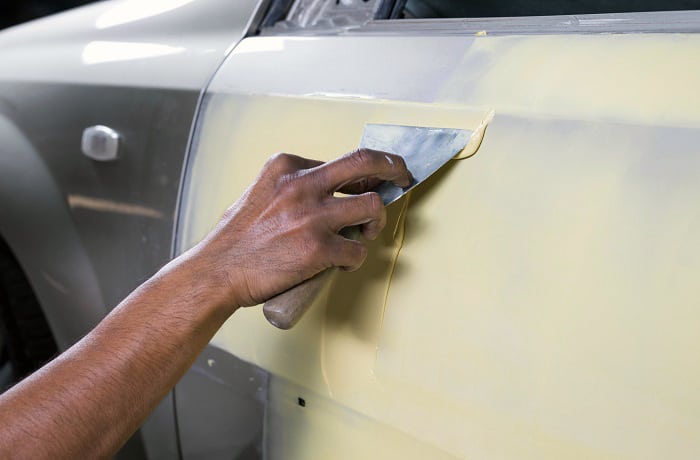
What Should Go First – Bondo or Primer?
When painting a car, Bondo should always come first before primer. If you are looking up whether you can Bondo over primer, chances are you forgot to apply the filler in the initial steps.
Or, you have just discovered a new dent when spraying primer. In case you have already applied primer, stripping it off so that you can apply Bondo seems like a lot of work.
This is why most DIY enthusiasts apply Bondo directly over primer, even if this isn’t the correct order on how you should go about things. When you follow the above tips, you shouldn’t run into any problems later.
While we are still on what should go first, this topic has sparked heated debates in most car online forums. Some people swear that primer should go first, and others claim vice versa.
As a car owner working on restoring your car’s paint job, these contrasting opinions can leave you confused, wondering what’s wrong and right.
When you find yourself in such a dilemma, we advise you to confirm with the instructions provided by your primer’s manufacturer. Some primer products require to be applied over Bondo.
Others have no problem when Bondo is applied to it. Following these instructions ensures you avoid incompatibility or adhesion issues once you are done applying both.
A good example of the above is the old lacquer primers. These required you to apply Bondo and then filler. However, some primers can easily accommodate Bondo on top of them.
The bottom line is, that you have to find out what the manufacturer of your primer recommends. If they say that it’s okay to do so. Go right ahead.
What Happens If I Primer Over Bondo?
In most cases, primer should hold on very well over Bondo. For those who don’t know, Bondo comprises two-part resin, including plastic and talc. It is lightweight and, at the same time, porous.
Therefore, it should absorb primer easily. If you had started with the Bondo and now want to primer, there shouldn’t be any cause for concern as long as the manufacturer of the primer recommends this is how it should be used.
Can Bondo Stick to Bare Metal?
Yes, it can. Bondo is designed in a way that it can stick on primer, paint, and even bare metal. Before modern-day fillers were created, they were designed to stick on bare metal first before primer was applied.
When applying Bondo to bare metal, you should sand it once you are done. This ensures it leaves a smooth finish that can stick easily to paint.

✔ Fast and Reliable Repairs – Perfect for filling dents, rust holes, dings, and scratches, this original formula body filler is ideal for DIY and professional restorations.
✔ Quick Curing Time – Mixes easily with the included red cream hardener and dries in just 20 minutes, letting you sand and paint the same day.
✔ Smooth, Non-Shrinking Finish – Lightweight, spreads evenly, and won’t shrink or crack—great for prepping panels before paint.
✔ Versatile Surface Compatibility – Works on steel, aluminum, fiberglass, wood, and even concrete—not just for cars.
✔ Visual Mixing Guide – Salmon color appears when filler and hardener are fully blended for confident application.
How to Apply Bondo over Primer?
This is a fairly simple process that anyone can engage in, even without prior painting experience. However, you need to get it right if you want to achieve a more appealing finish.
Here is a quick guide on how to apply Bondo over primer;
-
Step 1
You should sand the primer. Sanding is crucial as it makes it easier for the Bondo to stick to the primer.
-
Step 2
Scoop the Bondo and apply it on the dent or scratch with a flat tool. Ensure that the Bondo is as smooth as possible. Don’t worry if you don’t get it right the first time. The next step will help you smoothen it better.
-
Step 3
Sand it gently. Bondo is a fairly smooth material and can thus be sanded easily. Using a fine piece of sandpaper, sand the Bondo until it’s fairly smooth.
Give the Bondo some time to dry. If you want a more uniform finish, you can apply a layer of primer on top of the Bondo.
Is It Recommended to Bondo over Primer?
Even if modern filler products can be applied over primer, it is not recommendable. Yes, it’s something you can do. But, it’s not something we would advise you to do.
Bondo, or in other words, filler, is more stable when applied to bare metal. This is why professional painters strip down all the paint, apply filler, and then spray primer before painting.
When you apply Bondo to metal directly, it has a chance of holding on for longer than it would on primer.
The reason why Bondo should be applied first before primer is because of the talc resin. This material is known to absorb moisture.
When you apply the Bondo over primer, there will be nothing sealing it from the environment. As a result, moisture will penetrate through, slowly destroying the Bondo.
With time, the filler will wear out completely. It will wear out faster if there are perforations or the paint job is done mediocrely.
Which Prevents Rust Better – Bondo or Primer?
One of the main concerns when applying Bondo first instead of primer is that it doesn’t have any rust-prevention abilities.
The reason why many car manufacturers apply prier first is to prevent the metal beneath from rusting. When you strip down all the paint and leave the metal bare, then apply Bondo first.
There won’t be any form of rust protection. Your car will remain susceptible to rust, which can be quite dangerous.
If you live in the rust belt, applying Bondo over primer seems a safer alternative than doing vice versa. When shopping for primers, you have to be careful since not all contain rust protection features.
You have to find one that has such properties, or you will be avoiding the inevitable. The much Bondo can do is conceal the rust.
Is It Safe to Bondo Over Paint?
If you are in a hurry to fix a dent or scratch on your car, then you can Bondo over paint directly. Then conceal it with more paint. However, this isn’t how Bondo should be used.
When you apply Bondo over paint, it doesn’t hold permanently. The layers of paint beneath prevent the Bondo from sticking to the metal. Therefore, the filler will only serve you for a while.
Secondly, because the filler is located too close to the surface, the talc resin will absorb moisture and weaken it over time.
If you have a scratch on your car and want to conceal it with Bondo, strip down the paint, sand it, apply Bondo, and primer, and then finish with a paint job.
Are Bondo and Primer the Same Thing?
No. Bondo is more of a filler, whereas primer is paint-like. Primer is what’s used to cover metal so that it can bond better with paint. On the other hand, Bondo is designed to cover dents and scratches on the car.
Both are used to improve car aesthetics, but they serve two different applications. You must know which to use depending on the results you want to achieve.
Should You Prime Over Dents or Apply Bondo First?
Spraying primer over dents is wrong. This is because the primer itself won’t be able to get inside the crevices of the dents. What you should do in such a scenario is to apply Bondo first.
The Bondo will cover the space on the dent and scratches. You should let it dry and then spray the primer. Bondo can fill a scratch that is at least a quarter inch deep.
If it’s deeper than that, you can modify the dent, then apply Bondo before spraying primer.
Can You Layer Bondo over Bondo?
In case you have layered your car with some Bondo in the past, you can always apply a new layer on top of it. Bondo is designed to be compatible even if it has already been cured.
Primer, on the other hand, it’s a different story. Depending on the product you are using, you may or may not spray new primer on top of an old layer.
If the brands are different, the primer won’t be compatible, and there may be an issue in the future. There is, however, a downside of layering Bondo over Bondo.
It may not hold permanently. If you want it to stick, make sure that you scuff and sand the layer of old Bondo.