
Even before answering this question, mixing spray foam and Bondo isn’t something we would recommend. No matter how severe or significant the rust spots are on your car, there are better methods of dealing with the rust, and this shouldn’t even be on your list.
However, if someone has recommended spray foam and Bondo as temporary fixes to your car rust problems, we will look deeper into this matter and give you a prediction of how long it may last.
You would be very lucky if spray foam and Bondo lasted for more than a year. Bondo is formulated to adhere to carbon fiber, wood, metal, and foam.
However, it will not hold on to Styrofoam. So, if this is the type of foam that you intend to layer Bondo with, you can start looking for other alternatives.
As we were saying, Bondo body filler is strictly formulated for particular surfaces. On foam, it can hold on for a while. But the structure on which Bondo is holding in is weak.
Therefore, it will collapse after a considerably short period. This may happen in a few weeks or months. If you plan to use spray foam and Bondo to repair scratches, then expect it not to last for long.
Is It Worth Layering Bondo Over Spray Foam?
The primary use of spray foam is to insulate the voids on a car to provide better temperature control and shield outside noises.
This product is not only famous for improving ride comfort, but due to its physical characteristics, it can easily fit in the crevices of your vehicle and doesn’t have to be molded by hand.
You can use it on the wheel wells, ceiling, floor, door panel, and any other place that you may consider applicable.
However, even if your goal is to use spray foam for insulation purposes, adding a layer of Bondo can affect the lifespan of both materials. Bondo will weigh down the weak structure of spray foam, and this will cause it to fall off after a while.
Layering Bondo over spray foam isn’t worth spending your time, effort, and money. If you are dealing with rust, there are better solutions out there.
Before considering any “quick fix,” you must identify where the rust is located. If the rust is on your rocker panels, this is a major safety issue. Rocker panels are not just cosmetic trim; they are critical structural members of a unibody vehicle.
They act as the “bridge” that maintains the cabin’s strength during a side-impact collision or a rollover.Using spray foam, Bondo, or even simple rivets on a rusted rocker panel provides zero structural strength.
In the event of an accident, a vehicle with compromised rockers may fold or collapse, significantly increasing the risk of injury. For these areas, welding 18-20 gauge sheet steel is the only industry-standard method to restore the vehicle’s original safety rating.
Should I Use Spray Foam as a Base for Body Filler?
Having seen that spray foam and Bondo don’t last very long, we must address the use of spray foam as a base for body filler.
If you are researching how long spray foam and Bondo last, chances are, you want to use spray foam as a base for body filler. Bondo is used as a filler during car paint and repair. On the other hand, spray foam is used for installation.
Another reason why you may be interested in knowing how long spray foam and Bondo last is because you are interested in a cheaper method to fix rust spots. You need to understand that you will always get exactly what you pay for when it comes to bodywork.
In this case, using spray foam as a base layer for Bondo may look decent at first, but there will be no strong structure beneath, and the Bondo will fall off as you are driving one day.
Not unless you want to spray the foam over the already rusted metal and use it as a surface to hold the two. But then again, a rusted piece of metal is equivalent to a space. Because rust spreads and weakens the metal. Eventually, it will spread around the foam, and that part can fall off.
Instead of spraying foam as a base filler, we would recommend cutting off the rusted metal and welding a new piece of 18-20 gauge steel. While riveting a patch is better than using foam, it does not restore the structural load path and is often considered a temporary bandage for structural areas like rockers.
You can add primer and sealer alongside the Bondo to protect the newly installed piece of metal from rusting. The good thing about Bondo is that it can conceal the added piece of metal from being visible. You, therefore, get a decent finish and a permanent solution against rust.
Can I Replace Spray Foam with Paper?
What you have to understand about bodywork is that the more wrong products you use, the shorter the repairs will last. Back in the day, people used newspapers as base layers for Bondo.
If one had a rust hole, they would patch it up with newspapers and add Bondo to the surface. Other than this being an old-school trick, you have to think twice about the strength of the structure supporting the Bondo.
Newspaper is light, and when it gets wet, it crumbles easily. Using that as a base layer for Bondo is completely absurd.
If you want Bondo to last for longer, use it on metal. If a particular area of your car has been eaten away by rust spots, don’t hesitate to weld a new piece of 18 to 20 gauge sheet steel before sealing it off with some Bondo.
This thickness matches the original factory specifications and provides the necessary rigidity to handle the stresses of the road. 18-gauge is often preferred for repairs because it is thicker and easier to weld without “burning through” the metal. Forget about spray foam and paper.

✔ Fast and Reliable Repairs – Perfect for filling dents, rust holes, dings, and scratches, this original formula body filler is ideal for DIY and professional restorations.
✔ Quick Curing Time – Mixes easily with the included red cream hardener and dries in just 20 minutes, letting you sand and paint the same day.
✔ Smooth, Non-Shrinking Finish – Lightweight, spreads evenly, and won’t shrink or crack—great for prepping panels before paint.
✔ Versatile Surface Compatibility – Works on steel, aluminum, fiberglass, wood, and even concrete—not just for cars.
✔ Visual Mixing Guide – Salmon color appears when filler and hardener are fully blended for confident application.
How to Fix Rust Holes with Bondo and Spray Foam?
As a website dedicated to giving you tips, guides, and information on all car matters, we will still explain how you can fix rust holes using these two.
Even though we don’t recommend it, spray foam and Bondo are excellent alternatives if you are interested in a low-cost and quick method of fixing rust spots.
Caution: Some use this method to hide rust before a state inspection, but this is highly discouraged. Concealing structural rust on rocker panels or frame rails with foam and Bondo is dangerous, as it hides a safety failure from inspectors and future owners without actually fixing the weakness.
Let’s get started on how you can fix rust holes with spray foam and Bondo.
1st step – Apply the Spray Foam on the Holes
In terms of quickness and easiness, this method stands out to be one of the best. However, welding or riveting a piece of metal is a much better alternative if you want a durable fix.
Back to spray foam. You can apply this product directly to rust holes in your car. The spray foam will fill in the rust holes, and even though they won’t attach permanently, it will get you through the next few months.
2nd step – Cut the Protruding Foam to Create an Even Surface
After filling the rust holes with spray foam, you will realize that it’s a little bit thick. To make the surface even, cut the foam to at least an inch thick from the car’s surface.
You can use a razor. You don’t need to be very consistent because Bondo will squeeze the foam deeper.
3rd Step – Prepare and Apply Bondo
For those who have used Bondo in the past, you are aware that it needs to be mixed with a hardener. So, combine these two in the appropriate ratio.
Don’t forget that too much Bondo can cause the mixture to harden quickly, thus affecting your working time.
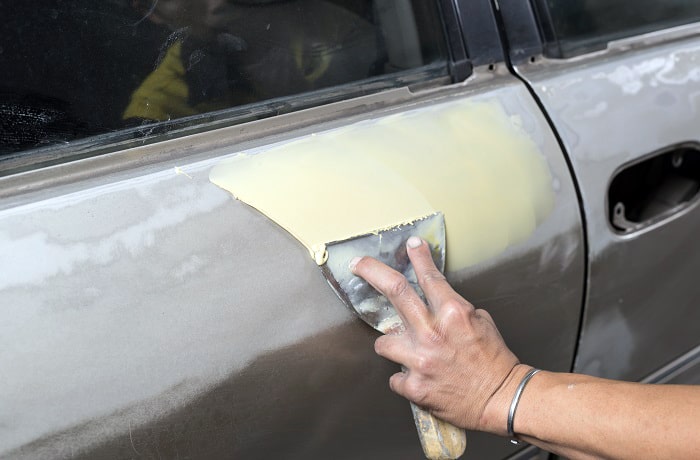
Once the Bondo and hardener are mixed in the correct proportion, spread it on the foam and surrounding area. Depending on how uniform you want the surface to be, you can spread it to a more extensive surface area.
4th Step – Spray Matching Paint
Give the Bondo some time to cure. Once that happens, you can grab your spray paint of choice and spray it on the Bondo. Choose spray paint that matches the color of your paint so that the finish looks decent.
That sums up the process of using Bondo and spray foam to cover rust holes. That can last for up to a year or several months, depending on the conditions your car is exposed to.
Why Shouldn’t I Use Spray Foam and Bondo to Cover Rust Holes?
We can think of many reasons you shouldn’t do that, and we will list all of them.
1. If you love your car, don’t go with this option.
Rust is the last thing you can ever expect to find on your vehicle. Rust lowers the resale value of your car, and if not dealt with, it can spread to other parts and render the vehicle unusable.
You haven’t dealt with the rust when you spray foam and Bondo over rust holes. You have just concealed it. The rust will spread beneath the new paint, Bondo, and spray foam.
The effects of rust may not be visible at the moment, but they can be drastic in the future.
2. It’s a quick method that doesn’t last for very long.
Bondo can last for years as long as it’s applied correctly. But, if you use it over foam, it won’t stick for long. After a few months, you will notice the Bondo falling off alongside the paint.
This can be avoided by welding metal over the rust holes and eliminating any corrosion on the surface. This latter method allows you to Bondo over the surface and watch it hold still for years.
3. Spray foam doesn’t conceal the hole on the other end.
When you spray foam and Bondo a rust hole, in most cases, you will only work on the visible part. The other part on the inside is left naked.
Holes in a car should be covered on both sides. If you leave the other side naked, the durability of this repair will be affected.
Don’t know how to weld but I have done just a wee bit of riveting, just enough to be dangerous. What kind of metal do you use as strength in a cleaned out rust area like rocker panels.
For rocker panels, you want real sheet steel, not mesh or thin patch tin. Something in the 18 to 20 gauge range is usually the right neighborhood, since it’s close to what many rocker skins use. On a unibody car, the rockers are structural; they keep the cabin from collapsing in a side-impact crash. The safest move is to cut all the bad metal out and weld in solid steel, not rely on rivets and filler as the strength layer. Rivets can help hold a non-structural patch, but on rockers they’re usually more of a temporary bandage than a real fix. If you’re not welding, I’d be careful calling any riveted patch “strength.” It can cover the hole and buy time, but it won’t restore the structural integrity the way properly fitted steel and welding will.