Grab the cheaper jug. Twist the cap. Pour five quarts and hope the engine agrees. That’s where the NAPA oil debate starts. Since the 1990s, NAPA has sold house-brand lubricants through thousands of stores under Genuine Parts Company.
The oil itself comes from a major blender, with Safety Data Sheets identifying Valvoline on current U.S. formulations. That link ties the jug on the shelf to a real R&D lab, not a mystery warehouse mix.
Modern engines don’t forgive weak chemistry. Turbochargers run hotter. Direct injection triggers LSPI. Timing chains stretch when detergents fall out of balance under API SP and GF-6A demands.
Some house brands cut corners and hide behind low prices. Others quietly mirror mainstream formulas at a lower shelf cost. Let’s find out where NAPA lands.
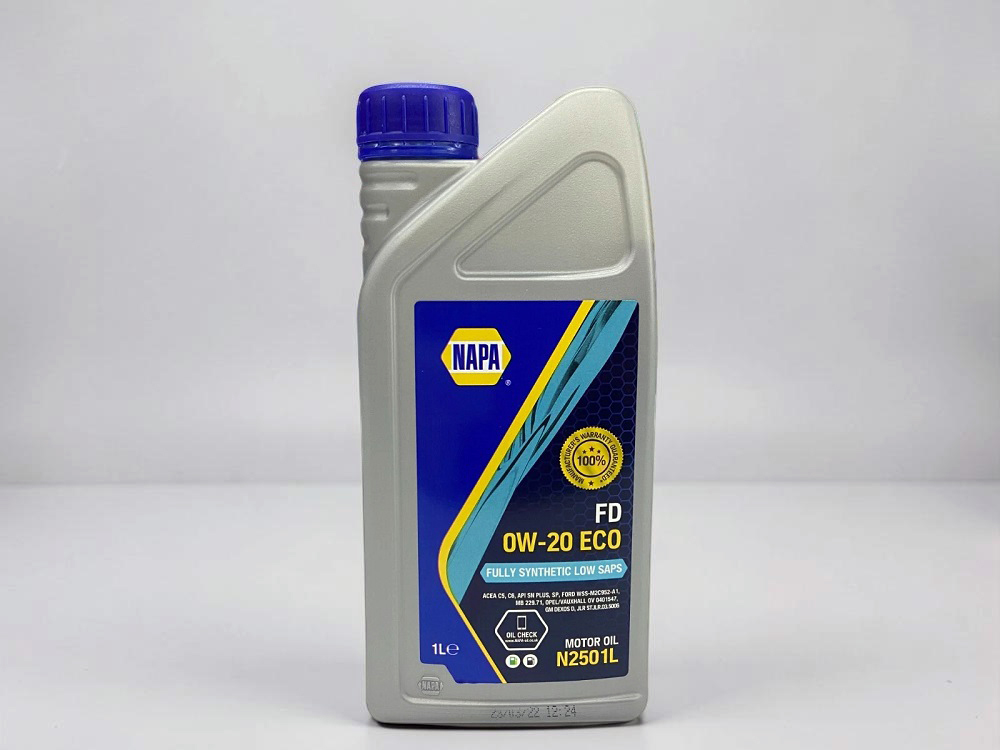
1. Who makes NAPA oil and why the blender matters more than the label
NAPA sells parts. It does not run refineries.
Scan the bottle and you’ll see the NAPA logo. Check the paperwork and you’ll find a different name behind it.
Genuine Parts Company owns NAPA and controls distribution across thousands of stores. It does not operate crude units, hydrocrackers, or additive plants. Blending happens through a contracted major manufacturer with full-scale refining and lab capability.
That structure locks NAPA into a large industrial supply chain with batch tracking, quality audits, and standardized formulation control across regions.
Safety Data Sheets point straight to Valvoline
Pull the SDS for NAPA Full Synthetic 5W-30 and the manufacturer line lists Valvoline on current U.S. documentation. CAS numbers for hydrotreated heavy paraffinic base oils match mainstream Group III synthetic stocks.
Physical properties align closely with Valvoline Advanced Full Synthetic in viscosity, flash point, and additive disclosure ranges. That signals shared blending infrastructure and additive sourcing.
When the blender already supplies OEM factory-fill contracts and fleet programs, the chemistry pipeline is built to meet API audit requirements and random marketplace testing.
Private label quality rises or falls with the supplier
Private label oil lives or dies by the blender’s test bench. A weak supplier shows thin additive levels and failed viscosity retention under ASTM D445 and D5293 testing.
PQIA testing on NAPA Premium Performance 5W-30 showed compliance with SAE J300 viscosity limits and labeled API categories. No contamination flags. No grade drift outside tolerance.
API licensing requires passing Sequence IIIH oxidation, Sequence IVB valvetrain wear, and LSPI testing under SP. Failing those tests means the product loses the certification mark.
2. What’s inside the bottle and how the chemistry holds up under heat and load
Group III base oil, built for daily heat cycles
Hydrocracked Group III base stocks form the backbone of NAPA Full Synthetic. These oils start as petroleum, then go through severe hydrocracking and isomerization. The process removes sulfur and unstable molecules.
The result holds viscosity under 230°F sump temps and resists oxidation during 7,500-mile drains. Modern Group III meets North American “full synthetic” labeling rules and passes Sequence IIIH high-temp oxidation testing.
Turbo center sections can see 400°F oil film temps after shutdown. Oxidation control at that heat decides whether the bearing housing cokes up or stays clean.
Additive package with real anti-wear chemistry
PQIA analysis of NAPA Premium Performance 5W-30 shows zinc around 787 ppm and phosphorus near 706 ppm. That confirms a healthy ZDDP anti-wear system within API limits.
Calcium sits above 1,200 ppm, with magnesium around 374 ppm. That balance supports detergent strength while reducing LSPI risk in turbo direct-injection engines.
Molybdenum and boron appear in measurable levels. Moly reduces boundary friction during cold starts. Boron boosts dispersant performance under soot and fuel dilution stress.
LSPI and timing chain wear drive modern formulation
API SP and ILSAC GF-6A forced detergent reformulation after 2020. High-calcium blends triggered pre-ignition in small turbo engines under low rpm load.
Updated magnesium balance cuts LSPI events that can crack pistons or bend rods. Sequence IX testing under SP targets that failure mode directly.
Timing chain wear testing under Sequence X measures elongation over controlled cycles. Fail the test and chains stretch early, leading to cam correlation codes like P0016 before 100,000 miles.
Elemental Additive Profile (PQIA Sample Data)
| Element (ppm) | NAPA 5W-30 Full Synthetic | NAPA 15W-40 Fleet | Mechanical Role |
|---|---|---|---|
| Calcium | 1,267 | 1,738 | Primary detergent, acid neutralization |
| Magnesium | 374 | 419 | Secondary detergent, LSPI mitigation |
| Phosphorus | 706 | 1,031 | Anti-wear (ZDDP component) |
| Zinc | 787 | 1,127 | Boundary wear protection under load |
| Molybdenum | 38 | 59 | Friction modifier, cold-start film support |
| Boron | 183 | 119 | Dispersant support, additive stabilizer |
3. Certifications that separate real oil from shelf noise
API SP and GF-6A set the survival bar
Modern gasoline engines demand API SP and ILSAC GF-6A. These categories launched in 2020 to address LSPI, chain wear, sludge, and turbo deposits.
SP requires passing Sequence IIIH for oxidation at 302°F oil temps. It also mandates Sequence IX for LSPI control in turbo direct-injection engines.
Fail those tests and the oil loses the API “donut” and “starburst.” No license means no warranty protection in most late-model engines.
What the spec means inside your engine
Sequence IVB measures valvetrain wear under stop-and-go conditions. Excess cam lobe wear shows up fast in high-rev DOHC designs.
Sequence X checks timing chain stretch after controlled cycles. Chain growth beyond limit triggers cam/crank correlation codes like P0017.
Sludge testing under Sequence VH simulates short-trip cold running. Heavy sludge blocks oil control rings and spikes consumption past 1 quart per 1,000 miles.
NAPA’s labeling aligns with current categories
Current NAPA Full Synthetic jugs display API SP and Resource Conserving marks. That confirms licensing under the API Engine Oil Licensing and Certification System.
Licensed oils undergo periodic marketplace audits. API can pull samples from shelves and test for compliance.
Losing a license exposes the brand to warranty disputes and recall-level liability under Magnuson-Moss rules.
4. Lab numbers that show whether the oil can hold its grade
Viscosity at 212°F tells you if it stays in class
PQIA measured NAPA 5W-30 at 9.7 cSt at 212°F. SAE 30 grade runs from 9.3 to 12.5 cSt.
That puts it inside the band with margin to spare. Drop below 9.3 and the film thins under load.
Thin film at 3,000 rpm on a hot day wipes rod bearings fast. Bearing failure turns into a $4,000 to $7,000 short block job.
Cold cranking numbers decide winter startup wear
Cold Cranking Simulator testing sets limits for each grade. A 5W oil must stay below 6,600 cP at -22°F.
Published data shows NAPA 5W-30 at 5,229 cP at -22°F. That allows faster flow to cam journals and turbo feed lines.
Slow flow on a cold start starves the top end for several seconds. Most engine wear happens before oil reaches 150°F.
Viscosity index and heat stability under long drains
NAPA 5W-30 shows a viscosity index around 157. Higher VI means less thinning as temps climb past 230°F.
Flash point sits near 224°C. Lower flash points often hint at fuel dilution risk.
Fuel dilution past 2% drops viscosity and raises wear metals in used oil analysis. Blackstone flags many samples once flash point falls below 385°F.
Physical Property & Bench Test Data
| Property | NAPA 5W-30 Full Synthetic | NAPA 5W-40 Euro LS | NAPA 15W-40 Fleet |
|---|---|---|---|
| Kinematic Viscosity @ 100°C (cSt) | 9.7 | 14.1 | 14.8 |
| Kinematic Viscosity @ 40°C (cSt) | 56.7 | 85.0 | 109.0 |
| Viscosity Index | 157 | 170 | 140 |
| TBN (mg KOH/g) | ~7.6 | 7.8 | 9.52 |
| Flash Point (°C) | 224 | 224 | 230 |
| CCS @ -22°F (cP) | 5,401 | – | – |
5. Turbo heat, direct injection, and where oil earns its keep
Turbochargers punish weak oxidation control
Spin a turbo at 180,000 rpm and oil becomes the only cushion. Center housings see oil film temps above 400°F after shutdown.
Poor oxidation resistance leaves hard carbon in the bearing housing. That coking blocks oil feed and return passages.
Blocked flow wipes the thrust bearing and starts shaft play. Turbo replacement runs $1,200 to $3,000 on most late-model engines.
Direct injection raises LSPI risk at low rpm
Turbo direct-injection engines run high cylinder pressure at low speed. Lug the engine at 1,500 rpm under load and LSPI can strike.
LSPI slams the piston before the spark event. Broken ring lands and bent rods follow fast.
API SP oils must pass Sequence IX LSPI testing. Fail that and small 1.5L to 2.0L engines can fail under normal throttle input.
Timing chains expose weak detergent balance
Modern engines use long, narrow chains with low tension. Sludge and varnish speed up wear at the pins and plates.
Stretch triggers cam correlation codes like P0016 or P0017. Cold start rattle often shows up around 80,000 to 120,000 miles when oil control falls off.
Chain replacement on transverse turbo fours can hit $1,800 to $3,500 once guides and tensioners are included.
6. Euro approvals and diesel specs that separate basic oil from real OEM coverage
ACEA C3 and low-SAPS chemistry under emissions stress
European engines run hotter and stretch drain intervals past 10,000 miles. Many require ACEA C3 low-SAPS oil to protect diesel particulate filters and catalysts.
NAPA European formulas list ACEA C3 on technical sheets. That spec limits sulfated ash, phosphorus, and sulfur to control aftertreatment damage.
Excess ash clogs a DPF and raises backpressure. DPF replacement on a BMW or VW diesel can exceed $2,500.
BMW, Mercedes, and VW approvals carry real test demands
BMW LL-04 approval requires extended oxidation testing and piston deposit control. Mercedes MB 229.51 and 229.52 demand strict wear and sludge limits.
VW 505.01 targets unit-injector cam wear under high contact stress. Flat tappet cam lobes fail fast on the wrong oil.
Official approval means the oil passed OEM bench and engine dyno testing. A simple “meets requirements” claim does not grant warranty backing under factory service plans.
Heavy-duty diesel and CK-4 durability
NAPA 15W-40 Universal Fleet Plus carries API CK-4. CK-4 addresses shear stability, soot handling, and oxidation under high EGR rates.
Kinematic viscosity at 212°F measures around 14.8 cSt. Phosphorus levels near 1,031 ppm and zinc around 1,127 ppm support stronger anti-wear in flat tappet and high-load valvetrains.
High soot without proper dispersant thickens oil and starves bearings. Spun rod bearings in a diesel pickup often mean a $10,000 long-block replacement.
7. High-mileage formulas and what they do inside a worn engine
Seal conditioners target leaks at the source
Past 75,000 miles, valve stem seals and crank seals harden. Heat cycles shrink the rubber and oil starts to seep.
NAPA High Mileage formulas follow Valvoline MaxLife chemistry. They include seal conditioners that swell and soften aged elastomers.
Reduced seepage cuts oil loss and lowers blue smoke at startup. Rear main seal replacement can run $800 to $1,500 in labor alone.
Higher additive load fights wear and sludge
High-mileage blends often carry stronger detergent and anti-wear packages. Elemental data shows solid zinc, phosphorus, and detergent levels.
Extra dispersants keep carbon from packing into piston ring grooves. Stuck rings spike consumption past 1 quart every 1,000 miles.
Cleaning ring packs restores compression and stabilizes idle quality. Severe oil burning can lead to catalyst damage above $1,200 per bank.
Real-world durability under routine service
Used oil analysis from labs like Blackstone often shows stable viscosity after 7,500 to 10,000 miles. Wear metals such as iron and aluminum trend within engine averages when change intervals stay reasonable.
Flash point and TBN readings guide safe drain length. Passenger car formulas show TBN around 6.5 to 9.0 at start.
Stretching past additive reserve invites acid buildup and bearing corrosion. Main bearing failure means a full rebuild that rarely lands under $4,000.
8. NAPA versus Mobil 1 and Pennzoil where the real gap shows up
Spec sheets first, branding second
Mobil 1, Pennzoil Platinum, and NAPA Full Synthetic all carry API SP in common grades. That means each passed the same core engine sequence tests.
Sequence IIIH, IVB, IX, and X do not change based on label color. Pass or fail is binary under API licensing.
In a stock daily driver calling for 0W-20 or 5W-30 SP, baseline protection aligns closely. Warranty coverage depends on the spec printed on the cap.
Where premium oils push further
Mobil 1 Extended Performance and boutique oils chase longer drain intervals. Some claim 15,000 to 20,000 miles under ideal conditions.
Extended drains demand higher oxidation resistance and stronger TBN retention. Skip oil analysis and stretch too far, and sludge forms in tight oil return passages.
Turbo DI engines with fuel dilution often shear oil faster than lab claims. Fuel dilution above 3% cuts viscosity and increases cam lobe wear rates.
Price math over 100,000 miles
A 5-quart jug of NAPA Full Synthetic often runs $24 to $26 on promotion. Mobil 1 commonly sits around $28 to $32 for similar grades.
Over 100,000 miles at 5,000-mile intervals, that gap can total $80 to $160. Miss changes to save $5 per jug and rod bearings don’t care.
Oil is a recurring maintenance cost, not a trophy purchase. A seized engine from neglect still costs $5,000 or more regardless of brand.
9. The hard assessment and where NAPA oil makes sense
When NAPA is the right call
Match viscosity and spec to the engine cap and NAPA holds up. API SP and GF-6A coverage protects most late-model gas engines.
Valvoline-backed blending ties the oil to established R&D and quality control. PQIA testing confirms grade compliance and solid additive levels.
For 5,000 to 7,500-mile intervals in stock engines, protection aligns with mainstream brands. Failures in that window usually originate from neglect, not label choice.
When formula selection matters more than brand
Turbo DI engines demand strict SP compliance to control LSPI. Euro cars require ACEA C3, BMW LL-04, MB 229.52, or VW 505.01 where specified.
Diesel trucks need CK-4 with higher zinc and soot control. Grab the wrong formula and aftertreatment systems suffer fast.
DPF clogging, catalyst poisoning, and cam wear do not wait for the next oil change. One wrong fill can void warranty coverage tied to OEM approvals.
When paying more can be justified
Track use, extreme heat, or 15,000-mile drains push oil beyond normal duty. Those conditions favor premium extended-drain formulations with documented interval testing.
High-output engines with tight bearing clearances also stress oxidation limits. Fuel dilution in short-trip turbo engines shortens safe drain windows.
Under normal commuting and sane intervals, NAPA oil meets the mechanical demands of modern engines. Ignore change intervals and even the best oil won’t stop a $6,000 rebuild.
Sources & References
- NAPA Premium Performance Synthetic Blend SAE 5W-30 API SN PLUS
- NAPA European Formula Motor Oil 5W40 Full Synthetic 1 qt (US …
- Is NAPA Synthetic Oil the same as Valvoline? : r/Cartalk – Reddit
- NAPA Auto Parts – Wikipedia
- Genuine Parts Company Announces Acquisition of Largest NAPA Independent Store Owner in the U.S. – PR Newswire
- Napa and Valvoline Synthetic 0W-20 are the same oil! : r/prius – Reddit
- Is there actually a difference between automotive oil brands? : r/cars – Reddit
- napa® full synthetic sae 5w-30 motor oil – SAFETY DATA SHEET
- Best Synthetic Motor Oil? Complete Guide – Cadence Petroleum
- Valvoline High Mileage MaxLife Motor Oil 5W30 Full Synthetic 1 qt (US) VAL 179
- Valvoline High Mileage MaxLife Motor Oil 5W30 Full Synthetic 5 qt (US) VAL 881169
- NAPA Premium Performance Universal Fleet Plus SAE 15W-40 Motor Oil
- sgs oil, gas and chemicals – oil condition monitoring labs statement of qualifications
- American Petroleum Institute | API | Latest Oil Categories
- Everything You Need to Know About GF-6 and API SP Motor Oil Standards. – Kendall
- New GF-6 and API SP Motor Oil Standards and What They Mean for SCL Customers
- NAPA MOTOR OIL
- N226-NAPA-PD-5W-40-LS.pdf – TECHNICAL DATA SHEET
- C3 5W-30 LS – TECHNICAL DATA SHEET
- Who Makes Napa Gold Oil Filters: Brand, Quality, and Industry Insights – Bitget
- NAPA Motor Oil 5W30 Full Synthetic 5 qt (US) NOL 75521 | Buy Online
- XTR 5W-30 LS – TECHNICAL DATA SHEET
- Find API SP and ILSAC GF-6 Engine Oils Here – Petroleum Service Company
- 18 Best Motor Oil Brands In 2025, Ranked – SlashGear
- Valvoline European Motor Oil 5W30 Full Synthetic 5 qt (US) VAL 881167 | Buy Online
- Valvoline European Motor Oil 5W40 Full Synthetic 1 qt (US) VAL 966 | Buy Online
- Valvoline European Motor Oil 5W30 Full Synthetic 1 qt (US) VAL …
- Valvoline European Motor Oil 5W40 Full Synthetic 5 qt (US) VAL 881166 | Buy Online
- Valvoline High Mileage MaxLife Motor Oil 5W30 Synthetic Blend 5 qt (US) VAL 881163 | Buy Online – NAPA Auto Parts
- Valvoline High Mileage MaxLife Motor Oil 5W30 Full Synthetic 5 qt (US) VAL 881169 | Buy Online
- Valvoline High Mileage MaxLife Motor Oil 5W30 Full Synthetic 5 qt (US) VAL 881169
- Valvoline High Mileage MaxLife Motor Oil 20W50 Synthetic Blend 1 qt (US) VAL 822381 | Buy Online – NAPA Auto Parts
- Valvoline Motor Oil Full Synthetic VAL 888020 | Product Details – NAPA Auto Parts
- You should know, NAPA Gold filters are no longer made by Wix – Reddit
- Which oil lab JG or Blackstone? | Good Sam Community – 2201518
- Where to get engine oil analyzed… – SpyderLovers
- Blackstone Laboratories: Oil Analysis
- synthetic | Blackstone Laboratories
- Which Oil is Best? – Blackstone Laboratories
- Oil Analysis from Blackstone Labs – the Pelican Parts Forum!
- Blackstone Labs oil analysis – results! : r/XVcrosstrek – Reddit
- r/ToyotaTacoma on Reddit: Just got my oil analysis back from Blackstone Labs. 161385 miles on the engine. Regular oil changes at 10k intervals with OEM 0w20 oil. Just switched to Valvoline restore and protect 5w30 and will be changing it every 5k miles. I’ll pull another sample after
- Why Chevron Havoline Tops the List of Best Motor Oils in 2025 – Costa Oil Change
- Mobil 1 Advanced Motor Oil 5W30 Full Synthetic 5 qt (US) MOB 124317 – NAPA Auto Parts
- Pennzoil platinum full synthetic vs Mobil 1 european : r/BMWZ4 – Reddit
- Mobil 1 0w-20 synthetic vs pennzoil platinum 0w-20? : r/MechanicAdvice – Reddit
- Mobil 1 vs Pennzoil Platinum synthetic : r/MechanicAdvice – Reddit
- Good Deal on 5W-30 Full Synthetic : r/smallengines – Reddit
- Mobil 1 Oil in Motor Oil by Brand – Walmart.com
- Popular Synthetic Oil Brands Ranked Worst To Best
- SOLUTIONS
- 6 Best Synthetic Oil 2025 (The Only Guide You Need) – YouTube
- Fluids and Lubricants Specifications – mtu Solutions
Was This Article Helpful?