
Hook a trailer. Climb a hill. Feel the Cherokee start to strain. Some KL models can tow 4,500 lb. Some stop at 2,000 lb. The hitch on the back does not tell the whole story.
Cooling, a transmission oil cooler, trailer wiring, and shorter 3.517 gearing changed what certain V6 4×4 models could do. Base V6 4×4 versions used 3.251 gearing and stayed in a lower class.
Trailhawk brings its own twist with off-road hardware and shorter gearing. The 2026 Cherokee heads the other way with a hybrid setup and a 3,500-lb ceiling.
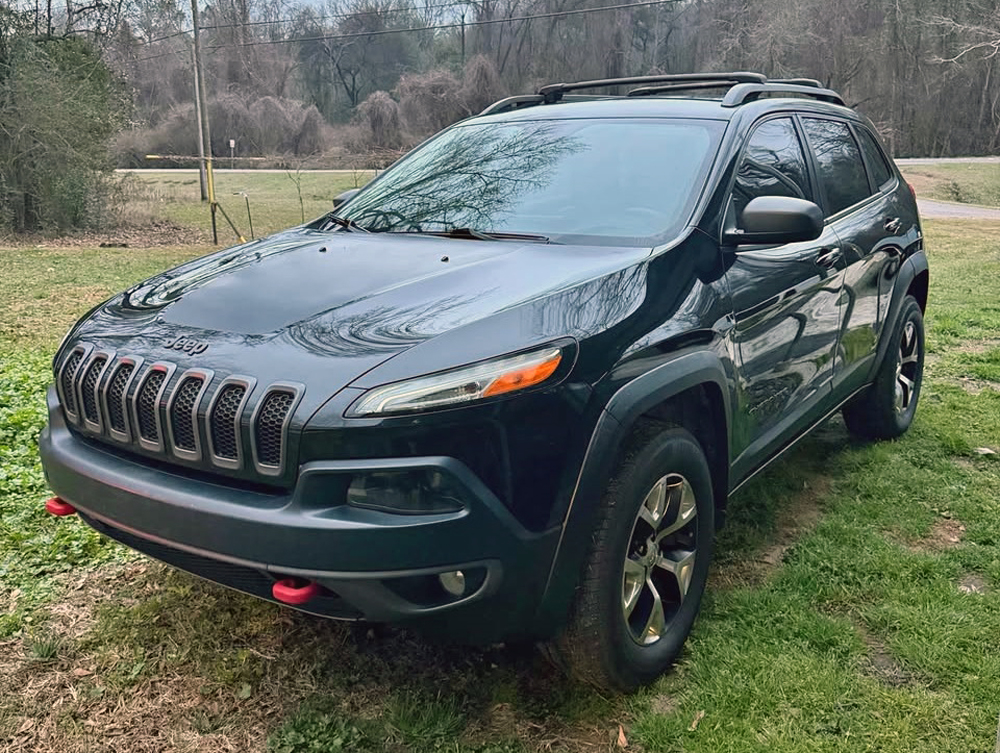
1. Start with the hard split under the bumper
A hitch does not unlock the real rating
Bolt a receiver to the back of a Cherokee and the tow rating does not magically jump. On the KL, the real dividing line sits in the factory hardware list and axle spec, not in the square tube under the bumper. Many V6 models without the full tow setup stayed capped at 2,000 lb. The properly equipped 3.2L 4×4 climbed to 4,500 lb.
That jump came from a package, not a badge. Jeep tied the higher number to heavy-duty engine cooling, an auxiliary transmission oil cooler, a Class III hitch, and both 4-pin and 7-pin wiring. On the key V6 4×4 setup, the axle ratio also changed from 3.251 to 3.517. That one gear change adds about 8.2% more torque multiplication at the axle.
The factory package changed the parts that actually suffer under load
Towing hits heat first. The engine works longer at higher load, and the 9-speed automatic has to hold, shift, and shear fluid while the trailer drags on it.
Once transmission fluid stays above about 230°F, it starts losing viscosity and film strength. That is where clutch control gets sloppy and long-term wear speeds up.
The tow-package cooler helps stop that slide. Mopar catalogs the KL transmission oil cooler as 68399021AB, and later Cherokee applications also used radiator assemblies such as 68525071AA for the heavier cooling duty.
A hitch from Curt or Mopar can carry trailer weight on paper. It does not add the cooling margin that keeps the gearbox alive on a summer grade.
| Factory tow-package item | Why it changes towing behavior |
|---|---|
| Class III receiver hitch | Gives the chassis the correct hardware base for mid-weight trailer loads |
| 4-pin and 7-pin wiring | Supports lighting, charge feed, and trailer-brake support |
| Heavy-duty engine cooling | Helps coolant temperature stay under control on long pulls |
| Auxiliary transmission oil cooler | Lowers 9-speed fluid heat under sustained load |
| 3.517 axle ratio on key 3.2L 4×4 models | Adds wheel torque and cuts down gear hunting |
Trailhawk already carried part of the answer
Trailhawk complicates the story in a useful way. Official Cherokee specs show Trailhawk and Active Drive II V6 models already used the 3.517 ratio. That means some of the tow-friendly leverage was already built into the off-road driveline.
The rest of the rating still depended on the full package. Gearing helps launch the load and hold speed. Cooling and wiring decide whether the vehicle can keep doing it without overheating or losing control support. The ceiling stayed 4,500 lb only when the whole system was there.
2. Gearing does the heavy pulling before horsepower ever saves the day
The axle ratio is the real muscle move
The biggest tow-package change sits in the differential. On the KL, the standard 3.2L V6 4×4 used a 3.251 axle ratio. The tow-rated version moved to 3.517. That shorter gear gives the wheels more leverage every time the engine turns.
That matters most when the trailer starts from a stop or drags speed down on a grade. The engine does not have to fight as hard to get the load moving. The transmission also spends less time chasing the right gear under throttle.
The gain is small on paper and clear on the road
The jump from 3.251 to 3.517 works out to about 8.2% more torque multiplication at the axle. That is not brochure fluff. It changes how the Jeep leaves a stop, how often it downshifts, and how long it can stay in a useful part of the powerband.
The KL used the ZF-based 948TE 9-speed automatic, and that gearbox does not like weak leverage under load. With taller gearing, it can start hunting between upper ratios when the trailer adds drag. The 3.517 ratio cuts that behavior down before heat starts climbing.
Engine size alone did not decide the rating
The 2.4L Tigershark proves that point fast. It could run aggressive gearing, including 3.734 and some 4.083 setups, and still stayed capped at 2,000 lb. Its torque output, about 171 lb-ft, put a hard ceiling on what the powertrain could carry without overstress.
The 3.2L Pentastar V6 had the torque to use the shorter axle ratio properly. That is why the V6 4×4 with the right gearing and tow hardware reached 4,500 lb. The engine gave the package headroom. The axle ratio let it use that headroom.
| Cherokee KL setup | Axle ratio | Max tow rating |
|---|---|---|
| 2.4L I4 | 3.734 or 4.083, depending on setup | 2,000 lb |
| 3.2L V6 4×2 | 3.251 | 2,000 lb |
| 3.2L V6 4×4 without tow equipment | 3.251 | 2,000 lb |
| 3.2L V6 4×4 with tow equipment | 3.517 | 4,500 lb |
| 2.0L turbo I4 4×4 with tow equipment | 3.734 | 4,000 lb |
Trailhawk already carried the shorter gear
Trailhawk deserves its own note here too. On V6 models, Trailhawk and Active Drive II setups already used the 3.517 axle ratio as part of the off-road package. That gave them better crawl control off-road and better leverage with a trailer behind them.
The ratio alone did not finish the job. Cooling, wiring, and hitch class still decided the final rating. The axle got the load moving. The full package is what held the line at 4,500 lb.
3. Heat is what breaks the deal first
Towing loads the cooling system before it flatters the engine
A trailer changes the job fast. The engine spends more time under load, the converter works harder, and the transmission fluid takes more shear.
Long grades, hot weather, and low road speed stack heat where a crossover has the least spare room. That is where a normal-duty Cherokee starts running out of margin.
Jeep tied the higher tow setup to heavy-duty engine cooling and an auxiliary transmission oil cooler for a reason. The added load does not just raise coolant temperature.
It also drives up underhood heat, condenser load, and the amount of hot fluid moving through the transmission. On the KL, towing turns thermal control into survival hardware.
The 9-speed is the part that gets punished first
The 948TE 9-speed automatic can feel smooth with no trailer behind it. Add weight, drag, and stop-and-go grade work, and fluid temperature becomes the main threat.
Once transmission fluid stays above about 230°F, its viscosity and film strength start to fall. That is where clutch apply quality slips and wear speeds up.
The auxiliary cooler is there to stop that slide before it turns into damage. Mopar lists the KL transmission oil cooler as 68399021AB.
Later Cherokee applications also used radiator assemblies such as 68525071AA on relevant 2019 models. Those parts exist because the tow-rated Cherokee needed more heat rejection than the standard setup.
Engine cooling had to step up too
The radiator had a bigger job on tow-rated KLs. It had to carry engine coolant heat while sharing airflow with the A/C condenser and the rest of the front heat-exchanger stack.
Slow climbs are where that gets ugly, because airflow drops while load stays high. Electric fans can only cover so much when the trailer keeps the throttle open.
That is why the heavy-duty cooling package matters even when the temp gauge still looks calm. Gauges are damped. Real thermal stress shows up first in fluid life, fan duty, and how often the transmission starts shuffling ratios under load.
The Cherokee’s higher rating depended on that extra cooling capacity, not on horsepower alone.
4. The wiring decides whether the trailer acts civilized
The 7-pin is where light towing ends
The connector matters more than most owners think. A basic 4-pin can run tail lamps, brake lamps, and turn signals. That is enough for a light utility trailer. It is not enough for the heavier jobs the higher tow rating points toward.
The factory tow setup added both 4-pin and 7-pin wiring. The 7-pin opens the door to trailer battery charge feed and brake-controller support. Once trailer brakes enter the picture, the Cherokee is dealing with current demand, not just lamp signals.
Charging load climbs fast once the trailer has its own needs
A trailer can pull power while the Jeep is already feeding fans, pumps, modules, lights, and cabin loads. That is why charging capacity shows up in tow-package discussions.
Cherokee specs put the standard charging system around 160 amps, with 180 amps available on heavier-duty applications. That extra output matters when the 7-pin charge line is feeding a drained trailer battery at the same time.
Electric brake controllers add another layer. They do not draw a steady trickle. They pulse current to the trailer’s brake magnets, and those pulses stack with the rest of the vehicle’s electrical load. Heat and low-speed towing make that worse because fan demand rises while alternator speed drops.
| Electrical demand while towing | Why it matters |
|---|---|
| Trailer lighting load | Adds steady draw on top of the vehicle’s normal lighting demand |
| 7-pin battery charge line | Can pull real current if the trailer battery is low |
| Electric brake controller output | Sends repeated current pulses to trailer brake magnets |
| Cooling fans at low speed | Increases alternator demand during hot-weather towing |
Factory wiring changed the way the Cherokee reacts
The factory harness did more than carry power. Integrated trailer wiring let the vehicle know a trailer was attached. That matters because trailer presence can affect stability-control logic and how the vehicle manages itself under load. A simple aftermarket T-connector cannot give the Jeep that same level of awareness.
That software gap matters on the road. A bolt-on hitch and a lamp harness can let a Cherokee pull a trailer. They do not fully duplicate the factory tow setup’s electrical integration.
The 7-pin hardware and higher-output charging support are part of why the properly equipped KL could hold a 4,500-lb rating.
5. Sway control steps in after the trailer starts to misbehave
The system reacts after the swing starts
Trailer sway usually starts with a shove. Crosswinds, a passing truck, bad tongue weight, or a soft rear suspension can kick the trailer side to side. Once that motion builds, the driver can run out of steering room fast. The Cherokee’s Trailer Sway Control was built to catch that motion after it begins.
This is an electronic stability-control job, not a hitch fix. The system watches yaw and steering data for the side-to-side pattern that matches trailer oscillation. When it sees that pattern, it steps in through braking and engine control. It does not wait for the driver to solve it alone.
It uses brakes and torque cut, not special effects
The first move is wheel braking. The ABS unit can clamp individual brakes to create a stabilizing force through the body. That helps slow the oscillation before it stacks into a bigger swing. The second move is torque reduction, which cuts engine pull and helps calm the whole combination.
Those two actions matter because sway feeds on speed. The faster the rig moves, the harder the trailer can shove the tow vehicle off line. Electronic intervention buys time, but it does not change trailer loading errors. A trailer with bad tongue weight can still sway hard enough to overwhelm the system.
Factory integration matters here too
The factory tow setup had an advantage beyond the hitch and cooler. Integrated trailer wiring let the Cherokee know a trailer was attached, which matters for stability logic.
A universal aftermarket harness can run lights and still leave the vehicle blind to trailer status. That gap can change how much help the electronics really give you.
Software also shapes how the driveline behaves under load. Factory tow prep can alter shift timing and stability behavior when a trailer is present.
A bolt-on hitch does not add those calibrations. The Cherokee can pull the trailer either way, but only one version was engineered around trailer motion control.
6. Payload is where the brochure starts lying by omission
The tow rating is only half the math
A Cherokee can sit inside its trailer rating and still be overloaded. The reason is payload. Payload has to carry people, cargo, and trailer tongue weight at the same time. On the KL, that number was often around 1,000 lb.
That is a small bucket once a real trailer shows up. A 4,500-lb trailer usually puts about 450 lb on the hitch at 10% tongue weight. Use 15%, and that number jumps to 675 lb. The trailer can be legal on paper and still eat most of the Jeep’s carrying room before a suitcase goes in.
Tongue weight crushes compact SUVs faster than owners expect
Tongue weight is not optional load. It sits on the rear suspension and counts against payload like people or gear. Put too little on the tongue and sway risk climbs. Put too much on it and the rear sags, front axle grip drops, and braking gets ugly.
The Cherokee does not have the mass or rear suspension reserve of a full-size tow rig. Once the rear settles, steering authority starts fading with it.
That matters most on wet pavement, downhill braking, and highway lane changes. A trailer that weighs 4,500 lb with a 12% tongue load puts about 540 lb straight into the payload math.
| Real-world loading item | Example weight |
|---|---|
| 4,500-lb trailer at 10% tongue weight | 450 lb |
| 4 adults at 150 lb each | 600 lb |
| Total before luggage or tools | 1,050 lb |
Families run out of payload before they run out of trailer rating
That table is where the Cherokee’s limits get real. Four adults at 150 lb each add 600 lb. Add a 450-lb tongue load and the Jeep is already at 1,050 lb before coolers, backpacks, or a hitch-mounted bike rack. That pushes past the rough 1,000-lb payload figure many KLs lived with.
The problem does not wait for a parts failure. It shows up in rear sag, longer stops, hotter brakes, and more strain on the cooling stack. Rear tire load climbs too, and that matters on a unibody SUV with little slack in reserve. Payload can shut the whole deal down before the trailer rating does.
GCWR still puts a second gate in front of you
Gross Combined Weight Rating is the other wall. It covers the full weight of the Jeep and trailer together. On V6 KL models, that combined number usually landed somewhere in the 8,500- to 10,000-lb range depending on year and configuration. The exact number belongs on the door sticker and tow label, not in guesswork.
That is why a loaded family Cherokee can hit the limit from both ends. Payload can be exceeded by tongue weight and passengers. GCWR can be exceeded by the Jeep, trailer, cargo, and fuel all added together. A trailer that fits the headline number can still be too much for the actual vehicle parked in the driveway.
7. Trailhawk pulls better than it looks, and worse than some people hope
Trailhawk came out of the box with real tow-friendly hardware
Trailhawk was not just an appearance trim with red hooks. On the KL, V6 Trailhawk models carried the 3.517 axle ratio and Jeep’s more serious Active Drive Lock hardware.
That gave the driveline better leverage at launch and better control on loose ground. It also put Trailhawk closer to the tow-ready side of the lineup before options were even discussed.
That ratio mattered on ramps, dirt, and steep starts. The shorter final drive let the 3.2L Pentastar V6 stay in a stronger part of the rev range. It also helped the 948TE 9-speed avoid lazy upshifts when the trailer started leaning on it. The rated ceiling still landed at 4,500 lb on the properly equipped V6 setup.
The off-road setup helps at the boat ramp
Trailhawk’s best towing trick shows up where pavement ends. The Active Drive Lock system added a locking rear differential and low-speed traction control meant for rocks and slick surfaces.
Those same tools help when a wet launch ramp, algae, mud, or loose gravel tries to spin one rear tire. A street-tuned crossover can sit there and roast a tire. Trailhawk has better odds of climbing out clean.
The crawl hardware also matters at low speed. Jeep quoted crawl ratios around 48:1 with the V6 and about 51.2:1 with the 2.0L turbo in the Trailhawk setup.
That kind of reduction helps the vehicle move a trailer with less throttle shock. Less throttle shock means less heat spike and less wheelspin when traction is poor.
The same hardware can make the trailer feel less settled on the highway
Trailhawk pays for that off-road talent on pavement. It rode higher than other Cherokee trims and usually sat on more aggressive tires. That changes how the body reacts when a trailer starts pushing from the rear. More ride height gives sway more leverage to work with.
The tire choice changes the feel too. Off-road rubber usually gives up some sidewall precision and on-road stability. That matters most during crosswinds, emergency lane changes, and downhill braking with tongue weight on the hitch.
Trailhawk can launch a trailer well, but it does not automatically make the combination calmer at 70 mph.
Trailhawk still needed the rest of the tow hardware
The axle ratio did not finish the job by itself. Cooling, hitch class, and trailer wiring still decided whether the Cherokee could hold the full rating without overheating or losing trailer-side support.
A Trailhawk with the right driveline but without the full tow hardware still had limits. The hard ceiling stayed 4,500 lb, not Class IV territory.
8. The ceiling gets obvious once the Cherokee is parked next to a Grand Cherokee
The Cherokee topped out where the bigger Jeep was just getting started
The KL could tow well for its size. With the right V6 4×4 setup, it reached 4,500 lb. That put it near the top of the compact-crossover crowd. It still lived inside Class III territory.
The Grand Cherokee worked in a different class. Recent factory guides put the 3.6L V6 around 6,200 lb, the 5.7L V8 at 7,200 lb, and the 4xe at 6,000 lb. The bigger Jeep had more wheelbase, more mass, a heavier hitch class, and more rear-suspension authority. Those are towing parts, not badge language.
The platform gap shows up in the hitch, the stance, and the rear suspension
The Cherokee used a Class III receiver. That hardware sits in the medium-duty lane, and aftermarket units like the Curt #13172 are commonly rated to 5,000 lb gross trailer weight and 750 lb tongue weight.
The vehicle itself still capped lower than the hitch. Cooling, payload, and platform size pulled the real limit back to 4,500 lb.
The Grand Cherokee moved up to Class IV hardware. That matters because the hitch is only one part of the load path. The bigger chassis also had more wheelbase and more curb weight to resist trailer shove. Some versions also offered rear load-leveling help, which the KL never had.
| Vehicle setup | Max tow rating | What sets the limit |
|---|---|---|
| Cherokee KL 2.4L | 2,000 lb | Engine torque and light-duty setup |
| Cherokee KL 2.0T with tow hardware | 4,000 lb | Stronger pull, still below the V6 peak |
| Cherokee KL 3.2L 4×4 with tow hardware | 4,500 lb | Best KL combination |
| Grand Cherokee V6 | 6,200 lb | Bigger platform, Class IV hitch, more chassis reserve |
| Grand Cherokee V8 | 7,200 lb | More torque and heavier-duty tow hardware |
| Grand Cherokee 4xe | 6,000 lb | Mid-size platform with hybrid torque |
The next Cherokee changed direction
The 2026 Cherokee heads down a different road. Jeep says it uses a 1.6L turbo hybrid, standard 4×4, and a CVT. The max tow figure drops to 3,500 lb. That is a full 1,000 lb below the best KL V6 tow setup.
The torque story changes too. Early specs point to about 210 hp and 230 lb-ft. Electric motors can help at launch, but the overall package no longer chases the old KL’s V6 tow ceiling. The new cap lands at 3,500 lb.
Sources & References
- 2019 Jeep Cherokee Group & Package Options Explained | Glenn E …
- How to Choose the Right Axle Ratio for Your Pickup Truck | Edmunds
- 2018 Jeep® Cherokee Canadian Specifications – FCA CANADA
- FCA CANADA 2019 Jeep® Cherokee SPECIFICATIONS – Amazon S3
- FCA CANADA 2020 Jeep® Cherokee SPECIFICATIONS – Amazon S3
- 2021 Jeep Cherokee Trailhawk 4×4 Features and Specs – Car and Driver
- Jeep Cherokee Trailhawk Towing Capacity Chart – Bice Motors
- Jeep Cherokee Configurations Mt. Pocono PA | Ray Price CDJR
- 2021 Jeep Cherokee Towing Capacity | Sam Leman Chrysler Jeep Dodge Bloomington
- Certified Pre-Owned 2020 Jeep Cherokee Trailhawk SUV in #11H2654A | Sid Dillon
- 2021 JEEP® CHEROKEE | Stellantis Fleet
- 2023 Jeep Cherokee Towing Capacity
- 2022 Jeep Grand Cherokee Towing Capacity
- Towing package? | NAXJA Forums – North American XJ Association
- 2019-2023 Jeep Cherokee Engine Cooling Radiator 68525071AA | Mopar Online Parts
- Genuine Jeep Cherokee Radiator – Mopar Parts Giant
- Engine Cooling Radiator – Mopar (68284108AA)
- Engine Cooling Radiator 68284108aa – Mopar OEM Parts Online
- Transmission Oil Cooler – Mopar (68399021AB)
- Genuine Jeep Cherokee Oil Cooler – Mopar Parts Giant
- Transmission Oil Cooler and Lines for 2021 Jeep Cherokee – Mopar OEM Parts Online
- How Much Can a Jeep Grand Cherokee Tow – Complete Guide | Magic City Auto Group
- Jeep Alternator Sizing – Simi Valley Chrysler Dodge Jeep Ram Blog
- A Guide to Replacing the Alternator on Your 2013-2022 Jeep Cherokee | Go-Parts.com
- 2025 Jeep Grand Cherokee Engine & Tow Specs | Barrington, IL
- Trailer Sway Control How It Works and Why It Matters – ProPride Blog
- Jeep Cherokee Tow Package: What You Need To Know – Secure2
- Stay Safe on the Road: Understanding Trailer Sway and Sway Control – Lerch RV
- Jeep Grand Cherokee Upgrades, Features, & Package Options
- 2014-2023 Jeep Cherokee Trailer Connector Kit – Hopkins 40974 – PartsGeek.com
- Seeking advice: I purchased Jeep Grand Cherokee as my tow vehicle. I thought I was all set until I read the manual. Now I’m totally lost… : r/GoRVing – Reddit
- WK2 3.6L V6 Alternator Choices : r/GrandCherokee – Reddit
- What Is Trailer Sway Control? – Kelley Blue Book
- Trailer Sway Control (TSC) – Mopar
- Everything You Need to Know About Trailer Sway Control | Equal-i-zer Hitch
- Why is Sway Control Important When Towing? | Equal-i-zer Hitch
- Understanding Trailer Sway Control: Ensuring Safe Towing – Vigor Air Ride
- Electronic vs. Mechanical Sway Control and How to Select One to Match Trailer | etrailer
- 2020 JEEP® CHEROKEE | Specifications – Amazon S3
- Class 3 Trailer Hitch, 2″ Receiver, Select Jeep Cherokee KL #13172 – CURT
- A Guide to Your Jeep® Brand Vehicle’s Towing Capacity
- 2025 Jeep Grand Cherokee Towing Capacity & Towing Guide
- 2023 Jeep Cherokee Towing Capacity
- Jeep Grand Cherokee Towing Guide | Jeep Dealer in Auburn, CA
- What is included in the Cherokee Trailer Tow Package? : r/Jeep – Reddit
- 2021 Jeep Cherokee vs. 2021 Jeep Grand Cherokee | Sam Leman Chrysler Jeep Dodge Ram FIAT Morton
- How much can the 2022 Jeep Grand Cherokee tow? – Star Dodge
- 2023 Jeep Cherokee Review: Performance, Specs, Features & Colors
- Towing and payload question : r/GrandCherokee – Reddit
- 2023 Jeep Cherokee Towing Capacity | Sam Leman CDJR of Peoria
- Jeep Trailhawk Model Specs
- Jeep Cherokee: Engine Options and Towing Capacity
- Jeep® Cherokee Capability
- 2019 Jeep Cherokee Trailhawk Review | Ray Price CDJR Mount Pocono PA
- 2020 CHEROKEE – Century U
- JEEP® CHEROKEE – Lum’s Auto Center
- 2026 Jeep Towing Capacity Guide
- 2026 Jeep® Cherokee Specs: MPG, Towing and More