
Pour the wrong blue coolant. Hear the heater gurgle. Watch temps start to drift. That’s how coolant trouble starts in a Subaru. Blue dye means very little by itself. The chemistry has to match the blue P-HOAT fluid Subaru used across the modern fleet.
This guide sorts the bottles that truly fit, the mixes that build sludge, and the service gap many owners miss. Factory fill runs to 137,500 miles. After that, the margin gets tighter.
1. Equivalent starts under the cap, not on the label
Subaru’s blue coolant changed the rules
A real match has to follow Subaru’s blue-coolant spec. Bottle color comes later. Subaru moved from older green coolant to blue Super Coolant as the lineup changed over, with blue coolant becoming the normal lane by 2009.
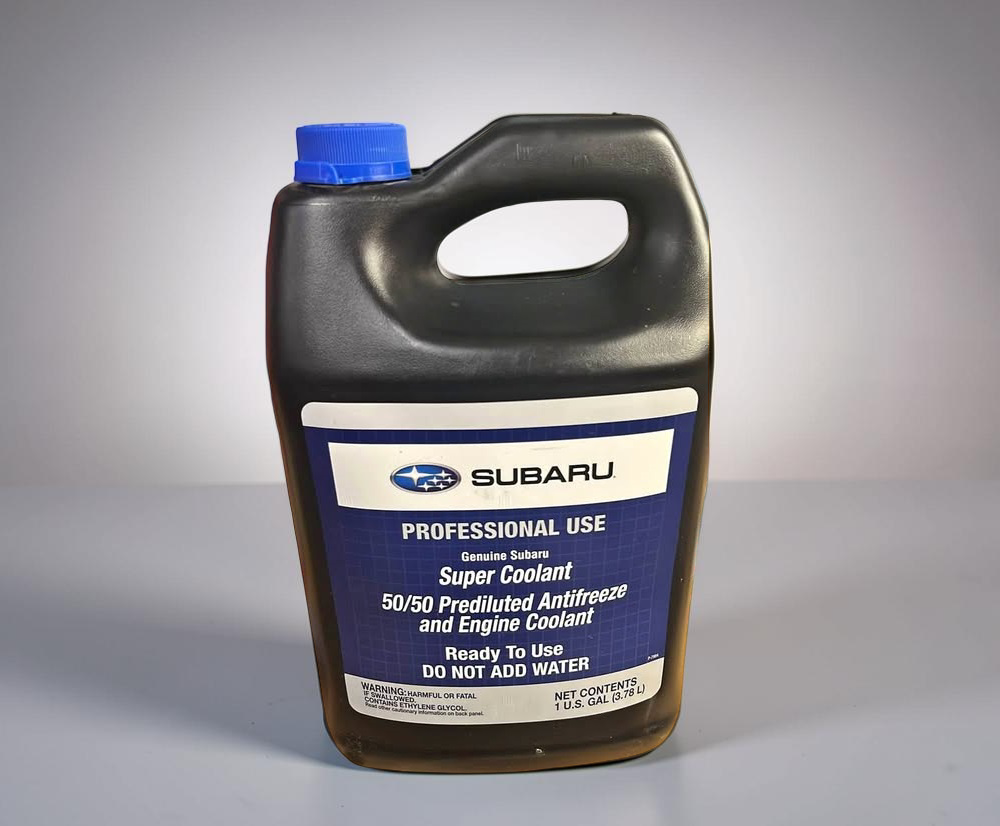
That shift changed the chemistry and the service life. The old green fluid lived in the short-interval world. Blue Super Coolant stretched first replacement to 11 years or 137,500 miles, then 6 years or 75,000 miles after that. Subaru’s own parts catalog still points back to genuine pre-diluted Super Coolant as the benchmark fill.
Blue dye still lies
A blue jug can still be wrong. Some bottles match Subaru’s phosphated HOAT lane. Some only borrow the color and stay vague where the inhibitor package should be clear.
That’s the trap at the parts shelf. “Asian blue” helps, but it doesn’t finish the job. You need written fit for Subaru’s blue systems, not a label that stops at dye.
| Subaru coolant era | Chemistry | Color | Service life |
|---|---|---|---|
| Older Long Life Coolant | IAT-style, silicate and borate based | Green | 30,000 miles / 24 months |
| Subaru Super Coolant | Blue phosphated HOAT | Blue | 11 years / 137,500 miles first fill, then 6 years / 75,000 miles |
| Good aftermarket matches | Asian blue P-HOAT or POAT type formulas | Usually blue | Depends on product and service history |
2. What has to match inside the coolant
The base fluid is simple, the inhibitor pack does the real work
Subaru Super Coolant starts with ethylene glycol. That handles freeze and boil control. The harder part is the inhibitor pack. Subaru’s blue coolant uses a phosphate-containing hybrid organic acid formula built for modern aluminum-heavy cooling systems.
That chemistry matters in a boxer engine. The heads sit in coolant all the time. That keeps the metal in a steady electrochemical bath, not a short splash cycle. Subaru needed a fluid that could protect aluminum fast and stay stable for years.
Phosphate does the quick surface work. Organic acids carry the long protection. Together, they form the blue P-HOAT lane that replaced the older green coolant family.
Brands call it different names, but the target stays the same
This is where the shelf gets messy. One brand says HOAT. Another says POAT. Subaru owners and import shops often call it P-HOAT.
The names shift, but the buying target does not. You want an Asian blue coolant with phosphate in the inhibitor package. You also want it free of silicates and borates, because that older additive path does not match what Subaru used in the blue-coolant era.
Valvoline’s Zerex Asian Blue calls out a silicate-free, borate-free HOAT formula. PEAK calls its blue fluid phosphate-enhanced OAT and lists Subaru 2009 and newer right on the fit claim. Those two labels tell you more than the dye ever will.
| What needs to match | Why it matters |
|---|---|
| Ethylene glycol base | Sets freeze and boil protection |
| Phosphate-containing Asian HOAT chemistry | Gives aluminum the fast passivation Subaru systems expect |
| Silicate-free and borate-free formula | Avoids the older additive path Subaru moved away from |
| Subaru 2009+ or clear Asian Blue fit claim | Screens out vague universal bottles |
| Pre-diluted with deionized water, or concentrate mixed with distilled water | Cuts scale and phosphate drop-out risk |
Water quality can ruin good coolant fast
Water still matters after you buy the right bottle. Subaru’s pre-mix uses deionized water for a reason. Hard tap water carries calcium and magnesium, and those minerals can react with phosphate inhibitors and leave scale behind.
That scale does real damage. It narrows radiator passages. It coats hot metal. It also cuts heat transfer where the cooling system needs clean flow the most.
A 50/50 mix sets the normal target. In that range, coolant gives freeze protection, boil margin, and stable additive balance. Push the mix wrong, or keep topping off with bad water, and the chemistry starts drifting before the service interval does.
3. The bottles that make the strongest case
Zerex Asian Blue earns a top-tier spot
Zerex Asian Blue makes one of the cleanest fit claims in this space. Valvoline sells it as an Asian blue coolant for vehicles that call for that chemistry, and the product language spells out a silicate-free, borate-free HOAT formula. That lines up well with what Subaru blue systems want.
It also gives you concentrate and pre-mix paths. That matters when the job calls for a full refill instead of a quick top-off. The technical record also notes hard-water compatibility and a 5-year, 150,000-mile service claim on the aftermarket side.
PEAK OET Asian Blue is just as hard to ignore
PEAK makes this easier than most brands do. Its Asian Blue formula names Subaru 2009 and newer in the fit language, including hybrids, and calls the chemistry phosphate-enhanced organic acid technology. That is the kind of label detail you want before the cap comes off.
PEAK also claims ASTM D3306 and JIS K2234 alignment in the technical record. Those spec references matter more than shelf color. The product is sold in both pre-diluted and concentrate form, which gives it real full-service credibility.
Pentofrost A3 fits the specialist-shop lane
Pentofrost A3 usually shows up where import shops buy by data sheet, not by end-cap display. CRP lists it for Asian vehicles that use blue coolant and calls out phosphates and organic salts, while excluding silicate, borate, nitrite, and amine additives. That is a strong chemistry story for a Subaru blue system.
The technical sheet goes deeper than most retail labels do. It lists a pH around 7.9 and density near 1.140 at 20°C. Those numbers sit close to the Subaru blue-coolant lane and help explain why Pentofrost keeps turning up in import repair bays.
Prestone MAX Asian Blue works best when shelf access matters
Prestone MAX Asian Blue belongs in the conversation, but lower in the stack. Prestone says it can top off or replace blue coolant in Subaru 2009 and newer vehicles. That makes it a real option when you need something today and the parts shelf is thin.
The issue is label sharpness. Prestone’s fit claim is broad and useful, but the tighter chemistry language from Zerex, PEAK, and Pentofrost gives those bottles a stronger paper trail for Subaru-specific work. Retail access helps, but it does not outrank a cleaner spec fit.
| Product | Strongest official claim | Editorial verdict |
|---|---|---|
| Subaru Genuine Super Coolant | OEM benchmark for Subaru blue systems | Safest no-argument choice |
| Zerex Asian Blue | Blue Asian HOAT, silicate-free and borate-free | Top-tier retail equivalent |
| PEAK OET Asian Blue | Subaru 2009+ fit, phosphate-enhanced OAT | Top-tier retail equivalent |
| Pentofrost A3 | Blue Asian fit, phosphate and organic salt chemistry | Strong specialist-shop equivalent |
| Prestone MAX Asian Blue | Subaru 2009+ top-off and replacement claim | Good retail convenience choice |
4. Mixing is where good coolant advice goes bad
Old green and modern blue don’t belong in the same casual top-off
This is the mix that causes the most trouble. Older Subaru green coolant came from the IAT side, with silicates and borates in the package. Modern blue Super Coolant lives in the phosphate HOAT lane. Blend those two carelessly, and the additive packs can start fighting each other.
The damage is not cosmetic. Mixed chemistry can build gel and sludge. That sludge can choke radiator tubes, slow heater-core flow, and cut heat transfer right where the boxer engine needs stable coolant contact. In the worst cases, the heads run hot enough to warp or push a gasket.
Universal coolant keeps causing false confidence
Universal coolant sells convenience. It does not guarantee the chemistry Subaru built around. Many of those bottles lean on broad OAT chemistry, often with 2-EHA, instead of the phosphate-based formula Subaru used in the blue-coolant era.
That difference matters over time. A universal fill may not gel right away. It can still miss the fast aluminum passivation Subaru’s system expects, and that leaves less margin for corrosion control inside the block, heads, and radiator.
| Bad mixing move | Likely result |
|---|---|
| Subaru blue with older green IAT | Sludge, blocked passages, weak heat transfer |
| Subaru blue with random universal coolant | Inhibitor mismatch, weaker long-term protection |
| Correct blue coolant topped off with hard tap water | Scale, phosphate drop-out, dirty passages |
| Unknown coolant history with repeated top-offs | Shorter fluid life and contaminated chemistry |
Water can wreck the mix even when the coolant started right
A lot of cooling systems get ruined one top-off at a time. Hard tap water carries calcium and magnesium. Those minerals react with phosphate inhibitors and leave deposits behind.
Once that starts, flow drops and hot spots grow. The radiator loses area. The heater core starts to gurgle. Keep guessing at what is already in the car, and a drain and refill turns cheaper than the next overheating event.
5. The interval drops after the first change, and the bleed job matters
Factory fill gets the long run, refill coolant does not
Subaru gives the first fill the long interval. That is 11 years or 137,500 miles. After the system gets opened and serviced, the next interval drops to 6 years or 75,000 miles.
That shorter clock is not dealer padding. A normal drain and refill does not pull every bit of old coolant out. Fluid stays trapped in the heater core, low passages, and parts of the block. Old coolant left behind drags down the new inhibitor pack from day one.
Boxer engines punish lazy air bleeding
Subaru owners know the sound. Refill the system badly, then hear sloshing behind the dash. That noise usually points to air trapped in the heater core, one of the high spots in the system.
Air in a Subaru cooling system does more than make noise. It leaves parts of the cylinder head without full coolant contact. On a boxer engine, that can raise local metal temperature fast and push the head gasket harder than the gauge suggests.
The refill has to be clean from bottle to funnel
Pre-mix helps here. Subaru’s own 50/50 coolant uses deionized water, and that matters once phosphate chemistry is in the system. Use tap water often enough, and minerals start building scale and phosphate drop-out inside the passages.
A concentrate fill can still work fine. It just needs distilled water and a proper mix. Get that wrong, and the coolant can lose heat-transfer margin before the service interval is halfway done.
| Service step | Why it matters |
|---|---|
| Use the correct blue Subaru-equivalent coolant | Keeps the inhibitor package consistent |
| Use pre-mix or mix concentrate with distilled water | Cuts mineral scale and phosphate drop-out |
| Bleed the system with a no-spill funnel | Pulls trapped air out of the heater core and heads |
| Follow the shorter refill interval | Accounts for partial old-fluid carryover |
| Stop layering mystery top-offs | Keeps the chemistry from drifting |
6. Newer Subaru hardware gives dirty coolant less room to hide
The Thermal Control Valve raised the stakes
Newer Subarus added another part that cares about coolant quality. Subaru service bulletins turned the Thermo Control Valve into a real repair topic on 2019 to 2021 Forester, 2020 to 2021 Legacy and Outback, and 2021 Crosstrek. That part replaced the old wax thermostat logic with an electronic valve that meters coolant flow by command, not by simple heat reaction.
That change tightened the system. A simple thermostat can tolerate some abuse before it sticks. A valve with finer passages and moving internal pieces gives sludge, scale, and debris less room to circulate without trouble.
Wrong coolant can jam more than the radiator
This matters most when owners treat universal coolant like a safe shortcut. Silicate-heavy or badly mixed coolant can leave gel, scale, or suspended junk in the system. On a TCV-equipped Subaru, that contamination has more places to cause trouble than it did on older layouts.
The record around these cars ties the TCV story to real fault behavior. When the valve goes bad, owners can end up staring at P26A3 and overheating warnings. A dirty cooling system does not guarantee that code, but it cuts the safety margin around a part that already became a known service item.
Modern coolant routing leaves less slack for bad service
Newer Subaru cooling systems route flow more actively than older cars did. That helps warm-up, emissions control, and cabin heat. It also means clean coolant and a clean refill matter more once valve-controlled hardware enters the loop.
Old-school top-off habits hit harder here. Leave mineral scale in the passages, or let sludge start forming, and the system loses flow where the valve, heater core, and hot aluminum surfaces need it most. P26A3 is one hard cutoff, and an overheating event lands a lot harder than a gallon of correct coolant.
7. Old conditioner advice still hangs around long after the coolant changed
Conditioner belongs to the old head-gasket era
Subaru coolant conditioner came from an older fight. It was tied to external head-gasket seepage on older EJ engines, especially the 2.5-liter SOHC years that built a reputation for weeping coolant. In that world, the little bottle acted like insurance against a known leak path.
That old advice stuck around longer than the hardware did. Subaru’s blue Super Coolant came later, along with MLS head gaskets and a different cooling-system baseline. The bottle language on Subaru Super Coolant also states it eliminates the need for added corrosion inhibitors.
Modern blue-coolant cars don’t need old stop-leak habits
A lot of owners still hear “Subaru coolant” and “conditioner” in the same breath. That causes trouble on newer cars. The record around modern FB and FA engines shows strong pushback against adding conditioner to blue-coolant systems unless Subaru called for it in that exact application.
The objections are mechanical. Conditioner can leave suspended material in the system. That can discolor the coolant, make visual checks harder, and add junk to narrow passages in the radiator and newer valve-controlled cooling circuits.
| Situation | Best call |
|---|---|
| Older EJ-era head-gasket seepage history | Conditioner can appear in legacy advice |
| Modern 2009+ Subaru blue-coolant service | Don’t assume conditioner belongs |
| Newer TCV-equipped Subaru | Keep particulate-style additives out |
The bottle in question still exists, but the use case got narrow
Subaru’s conditioner still shows up under part number SOA635071. That keeps the old habit alive in forums and some service counters. It does not turn the additive into a default step for every modern Subaru coolant service.
On a blue-coolant Subaru with modern hardware, extra particulate in the system is still extra particulate in the system.
8. Buy by fit, not by bottle color
The safest answer still wears a Subaru label
If you want zero guesswork, buy Subaru Genuine Super Coolant. It is the benchmark fill. It matches the chemistry, the water content, and the service language Subaru built around the modern blue-coolant fleet.
That matters most when the system history is messy. If the car has seen random top-offs, mixed brands, or an unknown last service, OEM fluid cuts one variable out of the job. The part most owners see is pre-diluted Super Coolant under SOA868V9270.
The best aftermarket picks are the ones with the cleanest paper trail
Zerex Asian Blue and PEAK OET Asian Blue sit at the top of the aftermarket stack. Both make clear fit claims for the Subaru blue-coolant era. Both stay in the phosphate-containing Asian coolant lane instead of hiding behind generic “all makes” language.
Pentofrost A3 belongs right behind them. It reads more like a shop fluid than a big-box shelf bottle. Prestone MAX Asian Blue still works as a real option, but it fits better as a convenience buy than as the strongest technical match.
| Owner situation | Best choice |
|---|---|
| Wants zero ambiguity | Subaru Genuine Super Coolant |
| Wants the strongest mainstream aftermarket match | Zerex Asian Blue or PEAK OET Asian Blue |
| Wants a specialist-grade alternative | Pentofrost A3 |
| Needs a common retail shelf option | Prestone MAX Asian Blue |
| Wants one bottle for every car in the driveway | Bad plan for a Subaru blue-coolant system |
The wrong buying habit usually starts with the word universal
This is where people save $10 and risk a lot more. A universal bottle can look easier. It also blurs the chemistry, the water quality, and the service history all at once.
Subaru’s blue systems want a clear fit story. That means phosphate-based Asian chemistry, silicate-free and borate-free language, and either pre-mix with deionized water or concentrate mixed with distilled water. Miss that lane, and the next gurgle, hot spot, or sludge cleanup starts getting expensive at 137,500 miles and beyond.
Sources & References
- PSA: Only use Subaru OEM coolant in all models newer than 2009 : r/cars – Reddit
- Coolant type : r/MechanicAdvice – Reddit
- Which Coolant is Right For My Subaru? – All Wheel Drive Auto
- Valvoline topped off my real Subaru coolant with their stuff, is that bad?
- coolant | The Irish Subaru Drivers Club
- PEAK ORIGINAL EQUIPMENT TECHNOLOGY™ Concentrate Antifreeze + Coolant For Asian Vehicles – BLUE – 1 Gal.
- RCM | Subaru Super Coolant | Subaru Antifreeze
- What is the maintenance schedule for my 2020 Subaru? – Customer Self-Service
- Pentosin Asian Vehicles Blue P-HOAT Antifreeze + Coolant Ready to Use 1 gal (US) AIC 8115207 | Buy Online – NAPA Auto Parts
- Zerex™ Asian Blue Vehicle Antifreeze / Coolant – Valvoline™ Global
- SUBARU Long Life Super Coolant Concentrate SOA868V9260 – Vector SDS and Chemical Management
- Safety Data Sheet
- OEM EJ25 coolant discontinued? : r/subaru – Reddit
- RAVENOL HJC Concentrate Protect FL22
- PEAK OE Asian Vehicles Blue OAT Antifreeze + Coolant Concentrate 1 gal (US) PEA PAB0B3 | Buy Online – NAPA Auto Parts
- Subaru OEM Blue Long Life Super Coolant Gallon (SOA868V9272) – STM Tuned Inc.
- valvoline™ zerex™ asian vehicle blue antifreeze coolant – CARiD.com
- Subaru OEM Super Coolant Pre-Mixed, 1 Gallon – Blue – Flatirons Tuning!
- PEAK OET Asian BLUE SPEC SHEET
- Super Tech OE Blue Antifreeze Prediluted 50/50 – Walmart.com
- RAVENOL HJC Concentrate Protect FL22 | RAVENOL
- Zerex™ Asian Blue Vehicle Antifreeze / Coolant – Valvoline™ Global
- Zerex Asian Vehicle Blue Antifreeze/Coolant 50/50 Pre-Mix Asian (Blue)
- Subaru Standard Engine Coolant and Antifreeze – Advance Auto Parts
- PENTOSIN ENGINE COOLANT / ANTIFREEZE – 8115207 | partzilla.com
- Pentofrost A3 | CRP Automotive
- Safety Data Sheet – Lordco Auto Parts
- Prestone® MAX Asian Vehicles (Blue) Antifreeze + Coolant
- Ravenol Subaru Coolant 5L – FflatFour Performance
- SuperCoolant demystified already? : r/subaru – Reddit
- Noob question: Can I just dump the 50/50 super coolant in the coolant reservoir and also can I mix conditioner in there, or is that just to be added directly to the radiator? : r/subaru – Reddit
- Is Subaru still using coolant conditioner in 2025? – Reddit
- Genuine Subaru Cooling System Conditioner Add To Coolant Head Gasket Maintenance
- SERVICE BULLETIN – nhtsa
- Genuine Subaru Coolant Conditioner-SOA635071 – Boxer4Racing
- Is coolant conditioner still required – Ultimate Subaru Message Board
- Subaru SOA635071 Coolant System Conditioner for sale online – eBay
- What Happens when You Mix Coolants – Valvoline™ Global Europe – EN
- The Dos and Don’ts of Mixing Coolant/Antifreeze – Prestone UK
- What Happens when You Mix Coolants – Valvoline™ Global
- PSA for the people who tell others or have been told to “only use Subaru coolant” – Reddit
- Can I use PEAK prediluted 50/50 antifreeze/coolant “for all vehicles?” : r/subaruimpreza
- Is generic blue coolant the same as Subaru super blue coolant? – Reddit
- Will any Asian blue coolant do? If so, anybody know of any concentrate sources? – Reddit
- SDS 819 Prestone® MAX Asian Antifreeze/Coolant Prediluted (Blue)
- Question I know it’s recommended to use Subaru coolant but is fine …
- Magnuson Moss Warranty Act – Injen Technology
- Magnuson-Moss Act, Aftermarket Auto Parts and Oil Change Facts
- Will adding aftermarket performance products void my car’s factory warranty? – RalliTEK
- Magnuson Moss Warranty Act – Florida Department of Financial Services
- PEAK Original Equipment Technology Asian Vehicles Extended Life BLUE 50/50 Prediluted Antifreeze and Coolant – Safety Data Sheet
- What coolant can I use? : r/WRX – Reddit